
UK housebuilding slump threatens thousands of small construction firms
13 November 2026
·
Liz Barclay
Share:
Residential building falls off a cliff as construction crisis deepens
Britain's construction industry is heading into a difficult winter, with housebuilding suffering its sharpest contraction of the year. The latest S&P Global Construction PMI has fallen to 43.6, while residential activity has plunged to just 35.1. For the small builders, plumbers, electricians and suppliers who depend on a steady flow of work, the figures point to fewer contracts, rising costs and growing pressure on cashflow.

Photo by Brett Jordan on Unsplash
Residential building falls off a cliff as construction crisis deepens
Britain's construction industry is heading into a difficult winter, with housebuilding suffering its sharpest contraction of the year. The latest S&P Global Construction PMI has fallen to 43.6, while residential activity has plunged to just 35.1. For the small builders, plumbers, electricians and suppliers who depend on a steady flow of work, the figures point to fewer contracts, rising costs and growing pressure on cashflow.
UK CONSTRUCTION SLUMPS AGAIN
The latest S&P Global UK Construction PMI has dropped to 43.6, down from 46.1. You may well ask what that means. Plain language never was a ‘thing’ in business research. The PMI is the Production Managers’ Index….. an index built around what production managers in each sector, as a profession, think is happening in their sector. They’re the people in the know and in this case, they think construction is shrinking, and the slowdown is accelerating. That’s the 22nd straight month in a row the index has been below 50 (the mark at which the sector would be seen to be stable; not growing but not slowing down either).
For small and micro businesses across construction, trades, materials, logistics and local supply chains, this is the index that screams ‘warning’.
Residential construction has fallen off a cliff
Residential activity has crashed to 35.1; the lowest level since December 2025. This is the part of the sector that employs the greatest number of small firms, such as the builders, plumbers and electricians. When housebuilding stalls and there are fewer new starts, small firms struggle to get new contracts, there are fewer enquiries for their services and longer gaps between jobs. There’s more competition for smaller projects.
Rising borrowing costs, weak consumer confidence and economic uncertainty are hitting homeowners and developers at the same time which is a double blow for the trades.
New work is drying up
Total new orders in October fell at the sharpest pace since June. This means pipelines of work are drying up, quotes aren’t converting into contracts, customers are delaying decisions, developers are pausing projects and lenders are tightening their lending criteria. The interest rate rise to 4%, on 5th November, won’t help.
For small firms, this creates stop‑start cashflow, which is one of the biggest causes of business failure.
Costs are rising again
Input cost inflation has jumped sharply. October saw fuel surcharges, higher energy bills, rising raw material prices and increased costs for aggregates, concrete, electrical items and steel. Almost half of construction firms reported rising input costs; up from a quarter in September.
Small firms can’t absorb these increases. They either pass them on and risk losing customers, absorb them and shrink their own margins, or delay work and weaken their cashflow. None of these options are good, particularly for small businesses with little in the way of resources to tide them over until work comes in again.
Supply chain delays are back
Construction buyers reported delivery delays for products and materials. This is a familiar headache and it’s returning at the worst possible time. Delays mean firms miss deadlines and have to reschedule jobs, leaving disgruntled customers, higher labour costs and wasted time on site. For micro firms, one delayed delivery can derail an entire week.
Civil engineering and commercial work hold up
Civil engineering jobs (45.9) and commercial activity (46.3) are still contracting, but more slowly. These are the bright spots with work on data centres, energy networks and utilities projects leading the way. These areas are seeing stronger demand, but they’re dominated by larger contractors. Small firms are only likely to benefit if procurement routes to these types of contracts open up to them.
Confidence is falling again
Construction firms are unsurprisingly cautious about 2027. Optimism is now at one of its lowest levels since late 2022 and that means firms will take on fewer people including apprentices, make fewer investments in equipment, people and expansion and be more defensive in their decision‑making. This slows the entire sector.
A hard winter
The PMI shows residential work collapsing, costs rising and confidence weakening. Small and micro businesses are facing tighter cashflow, more competition for fewer jobs, rising overheads and are at greater risk of going bust. The only resilience in the sector is coming from infrastructure and the opportunities in that sector need to be open to small firms, not just large contractors.
The construction slowdown affects, not just the sector, but local economies, small businesses and wider growth, and needs urgent attention.
Construction buyers have reported the lowest level of residential work since last December as the housing market continues to rag down the whole industry.
The bellwether S&P Global UK Construction Purchasing Managers’ Index recorded 43.6 in October – down from 46.1 the previous month.
The index registered below the neutral 50.0 value for the twenty-second month running.
Residential activity (index at 35.1) was by far the weakest-performing segment, with the latest reading the lowest since December 2025.
Civil engineering work (45.9) decreased in October, but the pace of contraction was the slowest since May 2025.
Commercial activity (46.3) also showed some resilience, although the latest reading eased from September’s 16-month high.
Total new work received by construction companies fell at the sharpest pace since June, reflecting subdued market conditions and fragile customer demand.
But there were some reports of improved order books due to higher infrastructure spending (data centres, energy networks and utilities projects).
Input cost inflation meanwhile accelerated sharply from the seven-month low seen in September.
The latest rise in purchasing prices was the steepest since June and well above the long-run survey average.
Many construction companies reported fuel surcharges, alongside increased energy costs and raw material prices (especially aggregates, concrete,electrical items and steel).
Tim Moore, Economics Director at S&P Global Market Intelligence, said: “October data indicated a setback for the UK construction sector after some signs of stabilisation in the previous month. Business activity decreased at the fastest pace since June amid the steepest reduction in residential work so far this year.
“Construction companies commented on severe headwinds in the house building sector from rising borrowing costs, weak consumer confidence and elevated economic uncertainty. However, there were reports of strong demand for data centre projects, alongside rising workloads in the energy and utilities sectors. Resilient infrastructure spending contributed to the slowest fall in civil engineering activity since May 2025.
“On the supply side, there were again delays with deliveries for construction products and materials. Moreover, input price inflation intensified, largely due to fuel surcharges and higher energy costs. Almost half of the survey panel (48%) indicated an increase in their input costs in October, up from 25% in September.
“Faced with rising input price inflation, higher borrowing costs and reduced order books, construction firms were unsurprisingly cautious about the year ahead business outlook. The degree of optimism towards activity growth eased again in October and now sits at one of the lowest levels since the end of 2022.”
Vistry has started wielding the jobs axe as it moves to more than half its regional operations amid worsening market conditions.
In a trading statement this morning, the house builder warned that average daily net debt was heading towards £800m in the second half as tough trading and delays to partner-funded deals squeeze cash.
Chief executive Adam Daniels said he had started driving through plans for a smaller business focused on generating cash and cutting borrowing.
The partnership homes focused house builder aims to slash its 25 operating regions to 12 from January.
He said new managing directors and management teams have already been confirmed to deliver the downsizing, although the firm has not revealed how many jobs will go.
The shake-up is targeting £50m of savings in 2027.
Daniels said: “We have also started the difficult but necessary process of reducing headcount and restructuring the operating regions, the new structure will be in place and operational from January.”
Average daily net debt is expected to reach around £800m in the second half, reflecting tough trading conditions and some partner-funded transactions slipping later into the final quarter.
Daniels added Vistry had begun refinancing its £900m term loan and revolving credit facility. He said several well-progressed land transactions were scheduled to complete before the year-end.
Private house sales remain difficult as affordability pressures and cautious buyers hold back demand. The group is tightly matching build rates to sales while adjusting prices and incentives on individual sites.
Partner-funded activity is building only gradually as funding starts flowing under the Social and Affordable Housing Programme.
Vistry has signed its £350m grant agreement with Homes England but said it would prioritise commercial terms, cash generation and returns over volumes.
Daniels said: “Our immediate priorities remain generating cash, lowering financial leverage, improving operational control and reducing complexity, whilst maintaining tight commercial discipline.”
Its forward order book stands at £3.1bn, down £200m on the half-year report, counting only exchanged or legally contracted orders after Vistry tightened its reporting criteria in September.
UK CONSTRUCTION SLUMPS AGAIN
The latest S&P Global UK Construction PMI has dropped to 43.6, down from 46.1. You may well ask what that means. Plain language never was a ‘thing’ in business research. The PMI is the Production Managers’ Index….. an index built around what production managers in each sector, as a profession, think is happening in their sector. They’re the people in the know and in this case, they think construction is shrinking, and the slowdown is accelerating. That’s the 22nd straight month in a row the index has been below 50 (the mark at which the sector would be seen to be stable; not growing but not slowing down either).
For small and micro businesses across construction, trades, materials, logistics and local supply chains, this is the index that screams ‘warning’.
Residential construction has fallen off a cliff
Residential activity has crashed to 35.1; the lowest level since December 2025. This is the part of the sector that employs the greatest number of small firms, such as the builders, plumbers and electricians. When housebuilding stalls and there are fewer new starts, small firms struggle to get new contracts, there are fewer enquiries for their services and longer gaps between jobs. There’s more competition for smaller projects.
Rising borrowing costs, weak consumer confidence and economic uncertainty are hitting homeowners and developers at the same time which is a double blow for the trades.
New work is drying up
Total new orders in October fell at the sharpest pace since June. This means pipelines of work are drying up, quotes aren’t converting into contracts, customers are delaying decisions, developers are pausing projects and lenders are tightening their lending criteria. The interest rate rise to 4%, on 5th November, won’t help.
For small firms, this creates stop‑start cashflow, which is one of the biggest causes of business failure.
Costs are rising again
Input cost inflation has jumped sharply. October saw fuel surcharges, higher energy bills, rising raw material prices and increased costs for aggregates, concrete, electrical items and steel. Almost half of construction firms reported rising input costs; up from a quarter in September.
Small firms can’t absorb these increases. They either pass them on and risk losing customers, absorb them and shrink their own margins, or delay work and weaken their cashflow. None of these options are good, particularly for small businesses with little in the way of resources to tide them over until work comes in again.
Supply chain delays are back
Construction buyers reported delivery delays for products and materials. This is a familiar headache and it’s returning at the worst possible time. Delays mean firms miss deadlines and have to reschedule jobs, leaving disgruntled customers, higher labour costs and wasted time on site. For micro firms, one delayed delivery can derail an entire week.
Civil engineering and commercial work hold up
Civil engineering jobs (45.9) and commercial activity (46.3) are still contracting, but more slowly. These are the bright spots with work on data centres, energy networks and utilities projects leading the way. These areas are seeing stronger demand, but they’re dominated by larger contractors. Small firms are only likely to benefit if procurement routes to these types of contracts open up to them.
Confidence is falling again
Construction firms are unsurprisingly cautious about 2027. Optimism is now at one of its lowest levels since late 2022 and that means firms will take on fewer people including apprentices, make fewer investments in equipment, people and expansion and be more defensive in their decision‑making. This slows the entire sector.
A hard winter
The PMI shows residential work collapsing, costs rising and confidence weakening. Small and micro businesses are facing tighter cashflow, more competition for fewer jobs, rising overheads and are at greater risk of going bust. The only resilience in the sector is coming from infrastructure and the opportunities in that sector need to be open to small firms, not just large contractors.
The construction slowdown affects, not just the sector, but local economies, small businesses and wider growth, and needs urgent attention.
Construction buyers have reported the lowest level of residential work since last December as the housing market continues to rag down the whole industry.
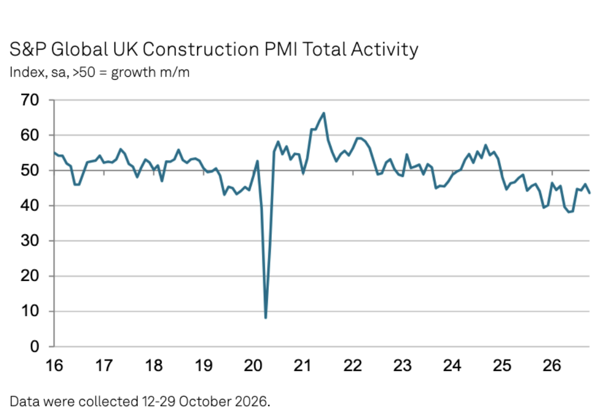
The bellwether S&P Global UK Construction Purchasing Managers’ Index recorded 43.6 in October – down from 46.1 the previous month.
The index registered below the neutral 50.0 value for the twenty-second month running.
Residential activity (index at 35.1) was by far the weakest-performing segment, with the latest reading the lowest since December 2025.
Civil engineering work (45.9) decreased in October, but the pace of contraction was the slowest since May 2025.
Commercial activity (46.3) also showed some resilience, although the latest reading eased from September’s 16-month high.
Total new work received by construction companies fell at the sharpest pace since June, reflecting subdued market conditions and fragile customer demand.
But there were some reports of improved order books due to higher infrastructure spending (data centres, energy networks and utilities projects).
Input cost inflation meanwhile accelerated sharply from the seven-month low seen in September.
The latest rise in purchasing prices was the steepest since June and well above the long-run survey average.
Many construction companies reported fuel surcharges, alongside increased energy costs and raw material prices (especially aggregates, concrete,electrical items and steel).
Tim Moore, Economics Director at S&P Global Market Intelligence, said: “October data indicated a setback for the UK construction sector after some signs of stabilisation in the previous month. Business activity decreased at the fastest pace since June amid the steepest reduction in residential work so far this year.
“Construction companies commented on severe headwinds in the house building sector from rising borrowing costs, weak consumer confidence and elevated economic uncertainty. However, there were reports of strong demand for data centre projects, alongside rising workloads in the energy and utilities sectors. Resilient infrastructure spending contributed to the slowest fall in civil engineering activity since May 2025.
“On the supply side, there were again delays with deliveries for construction products and materials. Moreover, input price inflation intensified, largely due to fuel surcharges and higher energy costs. Almost half of the survey panel (48%) indicated an increase in their input costs in October, up from 25% in September.
“Faced with rising input price inflation, higher borrowing costs and reduced order books, construction firms were unsurprisingly cautious about the year ahead business outlook. The degree of optimism towards activity growth eased again in October and now sits at one of the lowest levels since the end of 2022.”
Vistry has started wielding the jobs axe as it moves to more than half its regional operations amid worsening market conditions.
In a trading statement this morning, the house builder warned that average daily net debt was heading towards £800m in the second half as tough trading and delays to partner-funded deals squeeze cash.
Chief executive Adam Daniels said he had started driving through plans for a smaller business focused on generating cash and cutting borrowing.
The partnership homes focused house builder aims to slash its 25 operating regions to 12 from January.
He said new managing directors and management teams have already been confirmed to deliver the downsizing, although the firm has not revealed how many jobs will go.
The shake-up is targeting £50m of savings in 2027.
Daniels said: “We have also started the difficult but necessary process of reducing headcount and restructuring the operating regions, the new structure will be in place and operational from January.”
Average daily net debt is expected to reach around £800m in the second half, reflecting tough trading conditions and some partner-funded transactions slipping later into the final quarter.
Daniels added Vistry had begun refinancing its £900m term loan and revolving credit facility. He said several well-progressed land transactions were scheduled to complete before the year-end.
Private house sales remain difficult as affordability pressures and cautious buyers hold back demand. The group is tightly matching build rates to sales while adjusting prices and incentives on individual sites.
Partner-funded activity is building only gradually as funding starts flowing under the Social and Affordable Housing Programme.
Vistry has signed its £350m grant agreement with Homes England but said it would prioritise commercial terms, cash generation and returns over volumes.
Daniels said: “Our immediate priorities remain generating cash, lowering financial leverage, improving operational control and reducing complexity, whilst maintaining tight commercial discipline.”
Its forward order book stands at £3.1bn, down £200m on the half-year report, counting only exchanged or legally contracted orders after Vistry tightened its reporting criteria in September.
Share: